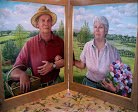
Day-lilies and white Agapanthus
Thursday, 27 August 2009
An empty garden
Day-lilies and white Agapanthus
Friday, 31 July 2009
A shaft of light before nightfall
Susanna continues to do well, and has today moved back to her own side of the bed, but I am still on cooking duty. A warming supper was what we needed: tagliatelli with meat balls in a tomato sauce. I ventured out for sage and a couple of bayleaves and came back dripping. A good flavour, though I say it myself, but most of the meatballs disintegrated into the sauce - another dish I haven't cracked yet, another challenge for the future!
Then as we ate, the clouds began to clear, bringing a shaft of sunshine from the West straight into my eyes. Knowing my shoes will be drenched in the wet grass, I am drawn out into the garden for the first time today.
I am reproached by the sodden piles of clippings from the Beech and Eleaganus hedges which I failed to collect yesterday before the rain began - please God tomorrow will bring a window to finish the task. I skimped on the Eleaganus this spring, and to get it straight I had to cut part of it back to bare wood, which I believe, fingers crossed, will sprout again. And once that's done, the evergreen oak (Quercus ilex) hedge by the road needs its annual trim - it is gradually creeping out and constricting the path.
The air is filled with flights of swallows, swooping low - several dozen over the garden, perhaps a hundred. On a dry day their cries fill the air, but this evening they are almost silent. I suppose the rain has prevented their feeding, and they are too hungry to waste energy on singing. They need to stuff themselves with insects to build up the energy reserves they need to return safely to sub-saharan Africa in a few short weeks. This wet weather must be a real threat to their lives.
I suppose the wet is good for my vegetables. I have never had such good brassicas - Brussels sprouts, Purple-sprouting broccoli and green Romanesco - though perhaps the barrow-loads of compost rotivated into their bed has something to do with it. And the climbing beans - Scarlet runners and three kinds of French beans, planted rather late - are close to the top of their poles. No trouble from the hares this year. We will be eating them in 10 days, but Susanna's dwarf beans started in pots in the conservatory have been cropping since early July. The rain has also suppressed bolting of the spinach beet, which we have been eating and giving away, and threatens to get away from us. Susanna's peas in the raised bed are a disappointment - I'm not sure why, but suspect they may be getting too little sun. And the potatoes are poor and showing the early signs of blight - I must dig them while I can, and perhaps I can get a late crop of peas from the ground too.
The wet must be good for the flowers too. Susanna's sweet peas continue to bloom their socks off - she has been able to get out to cut the seed pods, even though crutches prevent her from cutting bunches for the house. The Lobelia cardinalis, spared by the slugs this year, is about to burst. And the blue Agapanthus from South Africa is following on from the day-lilies and better than ever. The wonderful blue of Salvia patens has been joined by the slightly deeper blue of S. cacalifolia and day-glow pink Zinnias at the front of the croquet-lawn border, the first sunflowers at the back have opened butter yellow and copper, and the Dahlias are about to begin. S. uliginosa and S involucrata 'Bethelii' both survived last winter outdoors and promise to perform later on.
I made the mistake of reading the blogs commenting on the US Episcopal Church's recent General Convention and Archbishop Rowan Williams' reflection on it. The hatred and bile displayed by so many commentators is disgusting. Our Lord said (John 13:34-35), "I give you a new commandment, that you love one another. Just as I have loved you, you also should love one another, By this everyone will know that you are my disciples, if you have love for one another." If love is the test of discipleship, where may we find disciples today?
Sunday, 12 July 2009
Imagining a Future of Abundance
It cannot go on.
I think in our heart of hearts most of us realise that we cannot continue to live the way we are living now. The global civilisation we have built over the last 50 years – within my lifetime - is starting to falter. We are moving into a time of crisis. In the modern jargon, our way of life is unsustainable.
We are using up finite resources at an ever faster rate. The most obvious is fossil energy – oil, gas and coal – but there are others, including water and fertile soil. Already we have used up about half the oil on the planet; gas is following fast behind, and coal will inevitably follow, if rather later. The era of cheap energy is over.
Our agriculture and industries are damaging and poisoning the planet on which we live. The carbon dioxide we emit by burning fossil fuels and cutting down forests is causing global warming, about which I have written before. Scientists advise us that at best this will be very costly, and at worse catastrophic, both for us and for all the species we share the planet with.
Growth and consumption drive this crisis.
The global economy is focussed solely on them – when they stop for any reason we have a recession such as we are experiencing now. So governments try to stimulate investment to produce more stuff, so they can levy taxes to pay for the services we all want; and corporations try to boost sales to get rid of the stuff they make, so they can sell more and make bigger profits. Advertising encourages people to desire more. Fashion encourages them to throw away the old to buy the new. People are thus encouraged to work ever harder to earn the money to keep consuming and throwing away. But all too often this is at the expense of their relationships, their communities, and even their own health, as well as the planet. Children see less and less of their parents; volunteering and community spirit dwindle; unhealthy lifestyles make more people dangerously obese. And for all the increased consumption of stuff, people are no happier than they were - even in important respects less happy, studies show.
We have no option but to change. If we do so sensibly we can preserve this wonderful planet, so that our children and our children’s children can continue to enjoy our bountiful inheritance. But if we don’t, change will be forced on us by chaos and catastrophe. If you are one of those who doubt this, you owe it to yourself and your children to investigate the issues. A good starting point would be to watch Al Gore’s movie An Inconvenient Truth (on DVD from Amazon, price £4.98) and Annie Leonard’s The Story of Stuff (20 min to view free at http://www.storyofstuff.com/).
The crisis is spiritual
Many people look for technology to fix the crisis of our time, and I’m sure that will be part of the solution. But I am convinced we need more than that. In the wise words of Alastair McIntosh, a Quaker and Professor of Human Ecology at the University of Strathclyde,
The deep work must be this: to learn to live more abundantly with less, to rekindle community, and to serve fundamental human need instead of worshipping at the altars of greed.
Greed drives you and me to grasp more and more, to keep up with the Jones’s, as we ignore the damage caused to neighbours, the poor and the planet. Greed is at the root of the crisis. And greed is an old fashioned sin to which all human beings have been liable since the dawn of time. Our Christian faith has a lot to teach us about sin and how to overcome it. Jesus calls us to repent and believe in the good news, as the kingdom of God has come near. But how exactly should we respond to Jesus’s call in the face of this crisis?
I think we must all prayerfully seek answers to this question. Just as God loves variety, there will no doubt be a great variety of answers. But I believe that people in every parish should do so, and by God’s grace they are already finding their own answers. Here is a story about what a group of us in the Nenagh Union have been doing. Please let us know your stories!
Nenagh Carbon Watchers
For our Lent course this year a small multi-denominational group followed the Omega Climate Change course (see http://omegaclimate.wordpress.com/). It is stimulating, focussed on the scientific facts complemented by a little theology, and I heartily recommend it - if other parishes are interested in running it I would be glad to share our experience. We looked at why it is urgent to act now; how big our individual carbon footprints are and how to reduce them; global justice issues; how quality of life can be good in a low-carbon society; and how we might take action.
At the end we were so convinced of the need to act now that we decided to continue meeting as the Nenagh Carbon Watchers group. Our first aim is to support each other in our efforts to reduce our household carbon emissions – repentance must be personal, and each one must confront his or her own lifestyle. It should save us money as well as helping the planet. And we also aim to promote in our community the changes in lifestyle needed to flourish in the inevitable low-carbon, sustainable future.
We took the initiative to ask the election candidates standing in the Nenagh area to outline their positions and tell us what they would do if elected. We published their responses on our website (http://nenaghcarbonwatchers.blogspot.ie/), and local newspapers also printed the questions and a report on the responses. We were pleased to note that all who responded were positive – the need for change seems to be so widely agreed now that all are in favour of it, like motherhood!
A Future of Abundance
It is difficult to imagine what a low-carbon, sustainable future will be like, except in terms of what we must give up. It is easy to see such a future as poorer, greyer and less exciting than the present. It is tempting to fall into the trap of denial, to do nothing in the hope that the prospect will go away. But if we do we will be unable to make the sensible choices and we will be forced to suffer chaotic change.
I think we need urgently to re-imagine a future of abundance, and to do so as communities, so that we can begin to create it together in common purpose. Because the future can be one of abundance, and more fulfilling than today. What we need is a vision of the kingdom of God for the 21st century.
The Transition movement is one promising approach. This aims to stimulate groups within a local community to come together to envisage what must happen for the community to flourish in a sustainable future, to begin to plan for it, and to encourage stakeholders including local councils to buy into the vision. Started in Kinsale and piloted in Totnes in England, this model is rapidly being adopted in hundreds of communities in Britain and Ireland. You can read about in The Transition Handbook written by its founder Rob Hopkins (Amazon, price £8.28). The Carbon Watchers are actively mulling over whether and how to start a Transition Town initiative in Nenagh.
And I feel sure we can learn from the Eco Village in Cloughjordan, where construction started early this year (see http://www.thevillage.ie/).
Thursday, 2 July 2009
The most beautiful flower in the garden
But the most beautiful flower is not in her garden today - Susanna is in the Galway Clinic. She had hip-replacement surgery last Monday afternoon. It has gone well, thank God, the surgeon is pleased and she is cheerful. Although the wound is sore, she says the pain is much less than with her previous knee-replacements, and the pain she has been feeling in her knee has gone away, proving that it was referred from the hip, great relief to her. On Tuesday she was got out of bed to walk on a zimmer frame to the loo, yesterday she was able to swing her own leg out of the bed and sit in a chair and walk more, and today I think the physio will start her on crutches. Her main complaint is that they will not let her shower until Friday when they change the dressing!
In a little while I will drive back to Galway to be with her, and I shall be able to bring her a bunch of her own sweet peas and a punnet of her own strawberries, though I expect I shall be soaked if the rain doesn't stop!
Monday, 8 June 2009
Thomas Berry - requiescat in pace
He drew inspiration from a profound experience in childhood of a meadow filled with lilies, abounding with life. In later years he came to see this meadow as a deceptively simple test of goodness, writing in his essay The Meadow across the Creek:
Whatever preserves and enhances this meadow in the natural cycles of its transformation is good; what is opposed to this meadow or negates it is not good.He saw the work of God in the continuing revelation of the world around him, and drew hopeful conclusions for the future of humankind and our planet, writing in his book The Dream of the Earth:
His prophetic insights can guide us all, I think, as we struggle to deal with climate change, and as our global industrial civilisation teeters on the brink.If the dynamics of the Universe from the beginning shaped the course of the heavens, lighted the sun, and formed the Earth, if this same dynamism brought forth the continents and the seas and atmosphere, if it awakened life in the primordial cell and then brought into being the unnumbered variety of living beings, and finally brought us into being and guided us safely through the turbulent centuries, there is reason to believe that this same guiding process is precisely what has awakened in us our present understanding of ourselves and our relation to this stupendous process. Sensitized to such guidance from the very structure and functioning of the Universe, we can have confidence in the future that awaits the human venture.
Sunday, 7 June 2009
A View from the Pew – Is there a future for Religious Communities?
Waves of Community
For two millennia the worldwide Church has seen successive waves of enthusiasm for life in religious communities. Passionate Christians have felt drawn to live their faith in community with like-minded people, sharing everything in a common life of worship and service. Their communities are traditionally governed by a Rule – a sort of constitution, and each individual takes a vow - typically of poverty, chastity and obedience.
The first great wave began in the 4th Century, when Christians increasingly chose to withdraw from the world into enclosed monasteries. In part they sought stability: the times were turbulent, as Christians took over the institutions of the Roman Empire, and classical civilisation began its long descent into the dark ages. In Ireland, St Patrick’s successors were so inspired by monasteries like Lérins that the Irish Church came to be dominated by them. Irish monks like Columba, Aidan, Columbanus and Gall travelled across Western Europe in the 6th century founding new monasteries on the Irish model, in which learning was preserved through the dark ages.
By the 13th Century, the old enclosed monasteries had become rich and ceased to attract passionate newcomers. People like St Francis were inspired to found a second wave of communities, unenclosed and focussed on preaching and service to the poor. These orders of friars included Franciscans, Carmelites, Dominicans and Augustinians. Soon every town of any size in Western Europe, including Ireland, had one or more friaries.
By the 16th Century most agreed these communities in turn needed reform. When the Western Church split at the Reformation, the protestant reforming party suppressed both monasteries and friaries where they could, which included Ireland. But where the catholic party gained the upper hand, a whole new wave of communities, notably the Jesuits, formed and flourished alongside the older ones in their own Counter-Reformation.
The 19th Century saw yet another wave. New RC communities began to work in education, health care and the relief of poverty – for example, the Christian Brothers. And in the Church of England, under the influence of the Oxford Movement, the first Anglican religious communities were founded in the mid-Century, and later spread widely through the Anglican Communion.
We don’t do monks and nuns in the Church of Ireland. Or do we?
For whatever reason – I suspect sectarian prejudice - religious communities did not catch on in the Church of Ireland. Perhaps those who wished to devote their life to God were attracted instead to the foreign missions, to which the Church of Ireland has made such a great contribution. Yet many Church of Ireland men and women did feel called to live in community - they had to move to England to do so.
Among them was Ada Waller, a distant cousin on my mother’s side, the eldest daughter of Sir Edmund Waller of Newport, Co Tipperary. In 1859 aged 22 she joined the Community of the Holy Cross started by Elizabeth Neale, the sister of the hymn-writer J M Neale. As Sister Adelaide, she was clothed as a novice in 1860 (in this photo), professed in 1862, and remained in the Community until her death in 1923. She undertook mission work in London Docks from St George’s Mission House. What a change of life it must have been for this Tipperary girl, coming from such a privileged background, to serve the poorest of the London poor. The Community still exists, though it has moved to the East Midlands and is now Benedictine and contemplative. As part of their 150th anniversary celebrations one of the Sisters contacted me for details of Ada’s birth family and I was able to supply photographs. It is lovely to think that so long after her death she is still remembered by her Community, who in a very real sense became her true family.
What of the future?
Here in Ireland we have been shocked by reports of child abuse in Industrial Schools run by a few religious communities, and their superiors’ complicity in hiding it, just confirmed by a Commission of Enquiry. Numbers choosing to join traditional religious communities have collapsed dramatically over the last 50 years across the western world, including Ireland (though not in the 3rd world). We constantly read of communities withdrawing from their work and selling their houses, as their members dwindle and age. It must be so very sad for dedicated brothers and sisters to see their life’s work besmirched by the sins of a few, and their religious families petering out.
So is this the end of the 1500 year ideal of Christian religious community?
We are becoming familiar with new kinds of communities, such as the Taizé Community in France, the Iona Community in Scotland, and the Corrymeela Community in Northern Ireland, from which Bishop Trevor came to us. All these are ecumenical, with strong emphases on working with youth, on peace and justice, and on protecting our planet. From a small base of committed members they reach outward to the world, involving lay people, and creating a global presence through new communication technologies.
Brother Roger, founder of the Taizé Community
Some of the older RC communities, too, are reaching out. In our own diocese Glenstal Abbey does so through its recordings and annual ecumenical conferences – this June the topic is ‘A Change of Climate – breaking bread on a fragile earth’.
In the last few years a bewildering variety of new non-denominational communities have formed under the banner of ‘The New Monasticism’. Many come from evangelical protestant backgrounds, some are dispersed but linked by new technologies, and some include both men and women, and married couples. They take inspiration from Dietrich Bonhoeffer’s words written in 1935:
“…the restoration of the church will surely come only from a new type of monasticism which has nothing in common with the old but a complete lack of compromise in a life lived in accordance with the Sermon on the Mount in the discipleship of Christ. I think it is time to gather people together to do this…”
These are surely signs not of the death of religious community, but of the birth of yet another new wave!
As our global industrial civilisation begins to reach its limits and falter, we should not be surprised if more and more Christians choose to find stability in these new communities, as their predecessors did in the 4th Century. Those the Lord prospers will grow and flourish, probably alongside continuing traditional communities. We should see them as spiritual resources to draw on, as beacons to help us navigate our own turbulent times.