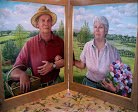
It is raining gently as I write this, looking out over Susanna's labyrinth garden, so full of colour and variety of form. The sweet peas for which she is famous, grown this year up a half circle of canes around the famine pot, have not been picked for five days and are a riot of colour - I must pick them this morning, to keep them blooming. The tree-mallow which I cut down to the ground in the spring has bounced back and is now a blaze of shocking pink. The day-lilies she got from a specialist nursery in Britain are in full blow, varying in colour from lemon yellow, through orange, to salmon pink and a rich, deep red. And the flower-buds of the blue and whit agapanthus are just begining to burst.
But the most beautiful flower is not in her garden today - Susanna is in the Galway Clinic. She had hip-replacement surgery last Monday afternoon. It has gone well, thank God, the surgeon is pleased and she is cheerful. Although the wound is sore, she says the pain is much less than with her previous knee-replacements, and the pain she has been feeling in her knee has gone away, proving that it was referred from the hip, great relief to her. On Tuesday she was got out of bed to walk on a zimmer frame to the loo, yesterday she was able to swing her own leg out of the bed and sit in a chair and walk more, and today I think the physio will start her on crutches. Her main complaint is that they will not let her shower until Friday when they change the dressing!
In a little while I will drive back to Galway to be with her, and I shall be able to bring her a bunch of her own sweet peas and a punnet of her own strawberries, though I expect I shall be soaked if the rain doesn't stop!
Thursday, 2 July 2009


Monday, 8 June 2009
Thomas Berry - requiescat in pace
Thomas Berry, priest, cultural historian and eco-theologist, has died aged 94. I feel compelled to mark the passing of this modern prophet, who often referred to himself as a geologian - an Earth scholar.
He drew inspiration from a profound experience in childhood of a meadow filled with lilies, abounding with life. In later years he came to see this meadow as a deceptively simple test of goodness, writing in his essay The Meadow across the Creek:
He drew inspiration from a profound experience in childhood of a meadow filled with lilies, abounding with life. In later years he came to see this meadow as a deceptively simple test of goodness, writing in his essay The Meadow across the Creek:
Whatever preserves and enhances this meadow in the natural cycles of its transformation is good; what is opposed to this meadow or negates it is not good.He saw the work of God in the continuing revelation of the world around him, and drew hopeful conclusions for the future of humankind and our planet, writing in his book The Dream of the Earth:
His prophetic insights can guide us all, I think, as we struggle to deal with climate change, and as our global industrial civilisation teeters on the brink.If the dynamics of the Universe from the beginning shaped the course of the heavens, lighted the sun, and formed the Earth, if this same dynamism brought forth the continents and the seas and atmosphere, if it awakened life in the primordial cell and then brought into being the unnumbered variety of living beings, and finally brought us into being and guided us safely through the turbulent centuries, there is reason to believe that this same guiding process is precisely what has awakened in us our present understanding of ourselves and our relation to this stupendous process. Sensitized to such guidance from the very structure and functioning of the Universe, we can have confidence in the future that awaits the human venture.
Sunday, 7 June 2009
A View from the Pew – Is there a future for Religious Communities?
View from the Pew is a regular column I write for Newslink, the Limerick & Killaloe Diocesan Magazine. This article appears in the June 2009 issue.
I recently stood in the rain on the beach at Juan les Pins on the French Riviera in the company of Brother Anthony Keane, the forester from Glenstal Abbey. He pointed out to me on the horizon the island of Lérins, with its famous monastery founded in 410 AD, where St Patrick is said to have studied. The monks now share the island, so he told me, with a nudist colony, which must make for some interesting encounters!
Waves of Community
For two millennia the worldwide Church has seen successive waves of enthusiasm for life in religious communities. Passionate Christians have felt drawn to live their faith in community with like-minded people, sharing everything in a common life of worship and service. Their communities are traditionally governed by a Rule – a sort of constitution, and each individual takes a vow - typically of poverty, chastity and obedience.
The first great wave began in the 4th Century, when Christians increasingly chose to withdraw from the world into enclosed monasteries. In part they sought stability: the times were turbulent, as Christians took over the institutions of the Roman Empire, and classical civilisation began its long descent into the dark ages. In Ireland, St Patrick’s successors were so inspired by monasteries like Lérins that the Irish Church came to be dominated by them. Irish monks like Columba, Aidan, Columbanus and Gall travelled across Western Europe in the 6th century founding new monasteries on the Irish model, in which learning was preserved through the dark ages.
By the 13th Century, the old enclosed monasteries had become rich and ceased to attract passionate newcomers. People like St Francis were inspired to found a second wave of communities, unenclosed and focussed on preaching and service to the poor. These orders of friars included Franciscans, Carmelites, Dominicans and Augustinians. Soon every town of any size in Western Europe, including Ireland, had one or more friaries.
By the 16th Century most agreed these communities in turn needed reform. When the Western Church split at the Reformation, the protestant reforming party suppressed both monasteries and friaries where they could, which included Ireland. But where the catholic party gained the upper hand, a whole new wave of communities, notably the Jesuits, formed and flourished alongside the older ones in their own Counter-Reformation.
The 19th Century saw yet another wave. New RC communities began to work in education, health care and the relief of poverty – for example, the Christian Brothers. And in the Church of England, under the influence of the Oxford Movement, the first Anglican religious communities were founded in the mid-Century, and later spread widely through the Anglican Communion.
We don’t do monks and nuns in the Church of Ireland. Or do we?
For whatever reason – I suspect sectarian prejudice - religious communities did not catch on in the Church of Ireland. Perhaps those who wished to devote their life to God were attracted instead to the foreign missions, to which the Church of Ireland has made such a great contribution. Yet many Church of Ireland men and women did feel called to live in community - they had to move to England to do so.

Among them was Ada Waller, a distant cousin on my mother’s side, the eldest daughter of Sir Edmund Waller of Newport, Co Tipperary. In 1859 aged 22 she joined the Community of the Holy Cross started by Elizabeth Neale, the sister of the hymn-writer J M Neale. As Sister Adelaide, she was clothed as a novice in 1860 (in this photo), professed in 1862, and remained in the Community until her death in 1923. She undertook mission work in London Docks from St George’s Mission House. What a change of life it must have been for this Tipperary girl, coming from such a privileged background, to serve the poorest of the London poor. The Community still exists, though it has moved to the East Midlands and is now Benedictine and contemplative. As part of their 150th anniversary celebrations one of the Sisters contacted me for details of Ada’s birth family and I was able to supply photographs. It is lovely to think that so long after her death she is still remembered by her Community, who in a very real sense became her true family.
Waves of Community
For two millennia the worldwide Church has seen successive waves of enthusiasm for life in religious communities. Passionate Christians have felt drawn to live their faith in community with like-minded people, sharing everything in a common life of worship and service. Their communities are traditionally governed by a Rule – a sort of constitution, and each individual takes a vow - typically of poverty, chastity and obedience.
The first great wave began in the 4th Century, when Christians increasingly chose to withdraw from the world into enclosed monasteries. In part they sought stability: the times were turbulent, as Christians took over the institutions of the Roman Empire, and classical civilisation began its long descent into the dark ages. In Ireland, St Patrick’s successors were so inspired by monasteries like Lérins that the Irish Church came to be dominated by them. Irish monks like Columba, Aidan, Columbanus and Gall travelled across Western Europe in the 6th century founding new monasteries on the Irish model, in which learning was preserved through the dark ages.
By the 13th Century, the old enclosed monasteries had become rich and ceased to attract passionate newcomers. People like St Francis were inspired to found a second wave of communities, unenclosed and focussed on preaching and service to the poor. These orders of friars included Franciscans, Carmelites, Dominicans and Augustinians. Soon every town of any size in Western Europe, including Ireland, had one or more friaries.
By the 16th Century most agreed these communities in turn needed reform. When the Western Church split at the Reformation, the protestant reforming party suppressed both monasteries and friaries where they could, which included Ireland. But where the catholic party gained the upper hand, a whole new wave of communities, notably the Jesuits, formed and flourished alongside the older ones in their own Counter-Reformation.
The 19th Century saw yet another wave. New RC communities began to work in education, health care and the relief of poverty – for example, the Christian Brothers. And in the Church of England, under the influence of the Oxford Movement, the first Anglican religious communities were founded in the mid-Century, and later spread widely through the Anglican Communion.
We don’t do monks and nuns in the Church of Ireland. Or do we?
For whatever reason – I suspect sectarian prejudice - religious communities did not catch on in the Church of Ireland. Perhaps those who wished to devote their life to God were attracted instead to the foreign missions, to which the Church of Ireland has made such a great contribution. Yet many Church of Ireland men and women did feel called to live in community - they had to move to England to do so.

Among them was Ada Waller, a distant cousin on my mother’s side, the eldest daughter of Sir Edmund Waller of Newport, Co Tipperary. In 1859 aged 22 she joined the Community of the Holy Cross started by Elizabeth Neale, the sister of the hymn-writer J M Neale. As Sister Adelaide, she was clothed as a novice in 1860 (in this photo), professed in 1862, and remained in the Community until her death in 1923. She undertook mission work in London Docks from St George’s Mission House. What a change of life it must have been for this Tipperary girl, coming from such a privileged background, to serve the poorest of the London poor. The Community still exists, though it has moved to the East Midlands and is now Benedictine and contemplative. As part of their 150th anniversary celebrations one of the Sisters contacted me for details of Ada’s birth family and I was able to supply photographs. It is lovely to think that so long after her death she is still remembered by her Community, who in a very real sense became her true family.
And we do indeed have nuns in the Church of Ireland, as I discovered on the web. The Community of St John the Evangelist is a group of Sisters formed in 1912 to live a hidden life of prayer and service. Never officially recognised by the Church of Ireland, they still run a Nursing Home in Ballsbridge, Dublin.
What of the future?
Here in Ireland we have been shocked by reports of child abuse in Industrial Schools run by a few religious communities, and their superiors’ complicity in hiding it, just confirmed by a Commission of Enquiry. Numbers choosing to join traditional religious communities have collapsed dramatically over the last 50 years across the western world, including Ireland (though not in the 3rd world). We constantly read of communities withdrawing from their work and selling their houses, as their members dwindle and age. It must be so very sad for dedicated brothers and sisters to see their life’s work besmirched by the sins of a few, and their religious families petering out.
So is this the end of the 1500 year ideal of Christian religious community?
Perhaps – but I for one very much doubt it!
We are becoming familiar with new kinds of communities, such as the Taizé Community in France, the Iona Community in Scotland, and the Corrymeela Community in Northern Ireland, from which Bishop Trevor came to us. All these are ecumenical, with strong emphases on working with youth, on peace and justice, and on protecting our planet. From a small base of committed members they reach outward to the world, involving lay people, and creating a global presence through new communication technologies.
We are becoming familiar with new kinds of communities, such as the Taizé Community in France, the Iona Community in Scotland, and the Corrymeela Community in Northern Ireland, from which Bishop Trevor came to us. All these are ecumenical, with strong emphases on working with youth, on peace and justice, and on protecting our planet. From a small base of committed members they reach outward to the world, involving lay people, and creating a global presence through new communication technologies.

Brother Roger, founder of the Taizé Community
Some of the older RC communities, too, are reaching out. In our own diocese Glenstal Abbey does so through its recordings and annual ecumenical conferences – this June the topic is ‘A Change of Climate – breaking bread on a fragile earth’.
In the last few years a bewildering variety of new non-denominational communities have formed under the banner of ‘The New Monasticism’. Many come from evangelical protestant backgrounds, some are dispersed but linked by new technologies, and some include both men and women, and married couples. They take inspiration from Dietrich Bonhoeffer’s words written in 1935:
“…the restoration of the church will surely come only from a new type of monasticism which has nothing in common with the old but a complete lack of compromise in a life lived in accordance with the Sermon on the Mount in the discipleship of Christ. I think it is time to gather people together to do this…”
These are surely signs not of the death of religious community, but of the birth of yet another new wave!
As our global industrial civilisation begins to reach its limits and falter, we should not be surprised if more and more Christians choose to find stability in these new communities, as their predecessors did in the 4th Century. Those the Lord prospers will grow and flourish, probably alongside continuing traditional communities. We should see them as spiritual resources to draw on, as beacons to help us navigate our own turbulent times.
Monday, 1 June 2009
Painted Ladies for Pentecost
The Painted Ladies (Cynthia cardui) have arrived, just in time for Pentecost! The East wind and the fine weather have brought them from the Continent in extraordinary numbers, arriving last Saturday - there must be several dozen in the garden, lighting it up like little tongues of flame, tiny creatures of the Holy Spirit, the great creator.
 Painted Lady on Borage
Another visitor brought by the East wind is the Hummingbird Hawk Moth (Macroglossum stellatarum). Like the Painted Lady it erupts from Europe, but not quite so frequently - I suppose I see it every 2-3 years. I remember when I first saw it, aged about 11 and a passionate collector of butterflies and moths, in my Grandmother's garden about 5 miles from here, during the family August holidays. I suppose that must have been a second brood, born in Ireland. What excitement! A fast and difficult prize, I eventually captured one in my net, which I killed with chloroform and set carefully to add to my collection. Now I regret it, becaue my collection has been lost over the years, and the memory of my first sight of it is a much finer treasure.
It promises to be a good year for foreign visitors, and I await another, the Clouded Yellow.
Today, Whit Monday, I have been labouring in the garden. The last vegetable bed has been rotovated. The climbing beans have been planted amid a strange tapering row of bamboo canes of different sizes - 4 different varities, but two left over from last year, Runner bean Polestar and French bean Blue Lake, may disappoint. A last row of Charlotte potatoes has also been interred - much too late, but we will see if anything comes of it. And 2 dozen young leeks. This is not an organic garden, and I have resorted to blue slug pellets in an attempt to banish the slugs, which are as ravenous as ever this year. I have also reseeded one of the Us of Yew with grass, and added more seed to some others which were patchy.
 Bearded Irises, brought back from France
Susaana's Labyrinth garden is looking gorgeous too, with lovely bearded Iris, Russel Lupins, Oriental Poppies and Roses. And the first flowers are showing on her famous sweet peas.
 Roses, Lupins and Poppies
 Japanese Irises in the Patio Pond, with Cistus behind
Tuesday, 26 May 2009
Summer has arrived!
Oh, what a gorgeous weekend we have just had! I think we can finally declare Summer has arrived at last, after the wettest May I think I ever remember. And that is as it should be. Last Thursday was Ascension Day, which I always think of as the first day of summer, perhaps because it was a school holiday and we were allowed out by ourselves to explore. I must have been just 13 when I went with a friend the same age on the train to Arundel. We boated on the River Arun in front of the Castle, and ate chinese goosberries - now called Kiwi fruit, but then a rarity - with our picnic.  Beautiful Borrisnafarney Church
After lashing with rain until noon on Saturday, the skies cleared and we went to beautiful Borrisnafarney Church to celebrate the wedding of my good friends' daughter Kirsten to Christian, followed by the christening of their baby daughter Zoe. The tiny church was full of children, and Paddy Anglican really needed his stentorian voice to make himself heard. I was fascinated by the fashionable, skimpy, feathery hats the ladies wore. Afterwards we were royally feasted at the Yacht Club by the bride's father Jack. And to cap it all, Leinster won the Heiniken cup!

 Zoe, Kirsten & Christian
 The Drive Border
The Nenagh Carbon Watchers is a group of individuals concerned about global warming who decided to continue meeting after last Lent's Omega Climate Change course. We wrote to the local and European election candidates with questions about their views on transition to a low carbon society. On Monday I pulled together the responses we received - I would have hoped for more - to write an article for the local newspapers. The candidates all support reducing carbon emissions and taking initiatives to help our communities flourish in a low-carbon future. It is good to know that the need for action is now so widely agreed that all are in favour of motherhood! I also put the responses up on a website - http://nenaghcarbonwatchers.blogspot.com/ - so that they are now a matter of public record.
Beautiful Borrisnafarney ChurchAfter lashing with rain until noon on Saturday, the skies cleared and we went to beautiful Borrisnafarney Church to celebrate the wedding of my good friends' daughter Kirsten to Christian, followed by the christening of their baby daughter Zoe. The tiny church was full of children, and Paddy Anglican really needed his stentorian voice to make himself heard. I was fascinated by the fashionable, skimpy, feathery hats the ladies wore. Afterwards we were royally feasted at the Yacht Club by the bride's father Jack. And to cap it all, Leinster won the Heiniken cup!
Kirsten & Christian celebrate in the Roller
Zoe, Kirsten & ChristianSunday broke with clear skies and news that the Volvo yachts had arrived in Galway in the early hours, with Green Dragon in 3rd place. I had a beautiful drive with Susanna to Shinrone and Aghancon to lead Matins - you can find the address on child abuse and John's kosmos-world here. This was the last of my regular jaunts to the Shinrone Union, because their new Rector will arrive in June. Afterwards Jean Talbot treated us to a superb Sunday roast lunch. On our return I should settled down to course work, but in the lovely sunshine I decided I just had to get to grips with the Drive Border, cutting back an overgrown Spanish broom, pulling nettles and giving Penstemon Ruby Garnet a hair cut.
The Drive BorderThe Nenagh Carbon Watchers is a group of individuals concerned about global warming who decided to continue meeting after last Lent's Omega Climate Change course. We wrote to the local and European election candidates with questions about their views on transition to a low carbon society. On Monday I pulled together the responses we received - I would have hoped for more - to write an article for the local newspapers. The candidates all support reducing carbon emissions and taking initiatives to help our communities flourish in a low-carbon future. It is good to know that the need for action is now so widely agreed that all are in favour of motherhood! I also put the responses up on a website - http://nenaghcarbonwatchers.blogspot.com/ - so that they are now a matter of public record.
Sunday, 17 May 2009
New Growth
I'm so pressed with course assignments, a sermon and a View from the Pew for Newslink, that I really don't have time to blog my own garden, but here are a few photos for Rogation Sunday!
 New leaves on a young walnut in the wild-flower meadow
 The Lime alley with daisies
 Bursting shoots on a Korean fir, with the first young cones

New shoots on the Quercus ilex hedge, showing colour variation
 The herb garden, l-r: Lovage, Purple Fennel, Lemon Balm, Sage
 Artichokes, promising a fine harvest
 Lupins just begining, in Susanna's Labyrinth garden
 Cowslips spreading in the side lawn
 Meadow Rue and Paeony buds in the Drive border
 Wisteria blooming as standards in the Labyrinth
O all ye works of the Lord, bless ye the Lord
Now it's May, the garden is burgeoning with fresh foliage:
New leaves on a young walnut in the wild-flower meadow The Lime alley with daisies
 Bursting shoots on a Korean fir, with the first young cones
New shoots on the Quercus ilex hedge, showing colour variation
 The herb garden, l-r: Lovage, Purple Fennel, Lemon Balm, Sage
low Box hedge in front
Artichokes, promising a fine harvestThe summer flowers are starting too:
Lupins just begining, in Susanna's Labyrinth garden Cowslips spreading in the side lawnMeadow Rue and Paeony buds in the Drive borderWisteria blooming as standards in the Labyrinth
O all ye works of the Lord, bless ye the Lord
Praise Him and magnify Him for ever!
Friday, 15 May 2009
Vertical Gardens
Susanna and I recently returned from a week's holiday with the Irish Tree Society on the Riviera, staying at Menton, just a few miles from the Italian border. We saw some beautiful gardens, but almost all of them were vertical, as you can see from these photos. Where the Alps run down to the Mediterranean, that is the only practical way to make a garden, building on existing olive terraces. They are beautiful, but difficult for those who do not walk well, including Susanna, when to see it properly you must go down 200 steps knowing that you must climb 200 steps back up again!
 And this photo shows the view of the sea from the terraces of Boccanegra at Vintimiglia, punctuated with cyprus trees.
 For me the most exciting plants to see were the exotic conifers which we cannot grow in Ireland, including several species from Australasia, including Araucaria bidwillii, A. cunninghamii, A. heterophylla (Norfolk Island pine), and Agathis australis (the mighty kauri of New Zealand).
This photo shows one of the olive terraces at the Villa Noailles at Grasse which has not been planted with exotics. The flowering meadow underneath the ancient trees was very beautiful, full of wild flowers including Green-winged orchid and a variety of Bee orchid.
And this photo shows the view of the sea from the terraces of Boccanegra at Vintimiglia, punctuated with cyprus trees.For me the most exciting plants to see were the exotic conifers which we cannot grow in Ireland, including several species from Australasia, including Araucaria bidwillii, A. cunninghamii, A. heterophylla (Norfolk Island pine), and Agathis australis (the mighty kauri of New Zealand).The weather was mixed - 2 fine days, 2 days of rain which I choose to ignore, and 2 fine days to finish.
Susanna and I took one day off visiting gardens, because her legs were giving her such problems, and I climbed up the hill in Menton to the old cemetry, which is stuffed with foreigners with English, German and Russian names. The inventor of Rugby football William Ellis is buried there, as is Aubrey Beardsley the strange English illustrator. But what fascinated me most was to discover an Irish relative of mine, one Caroline Laetitia Otway, daughter of one Admiral Robert Waller Otway of Castle Otway in Templederry, where I regularly lead Matins!
On our return I took Susanna over to see her orthopaedic surgeon in Galway, to see whether he could do anything to ease the pain she gets in her knee. The result - the problem is not with the knee, but with the hip. My poor dove must prepare herself for yet more surgery. It seems most unfair.
Subscribe to:
Posts (Atom)